
MOTS-c
Power Your Cells. Power Your Life.
What It Treats
How It Works
MOTC targets the mitochondria — your cells' power plants. It enhances the electron transport chain efficiency, meaning each cell produces more ATP (energy) with less oxidative waste. Think of it as a tune-up for every cell in your body.
Mechanism of Action
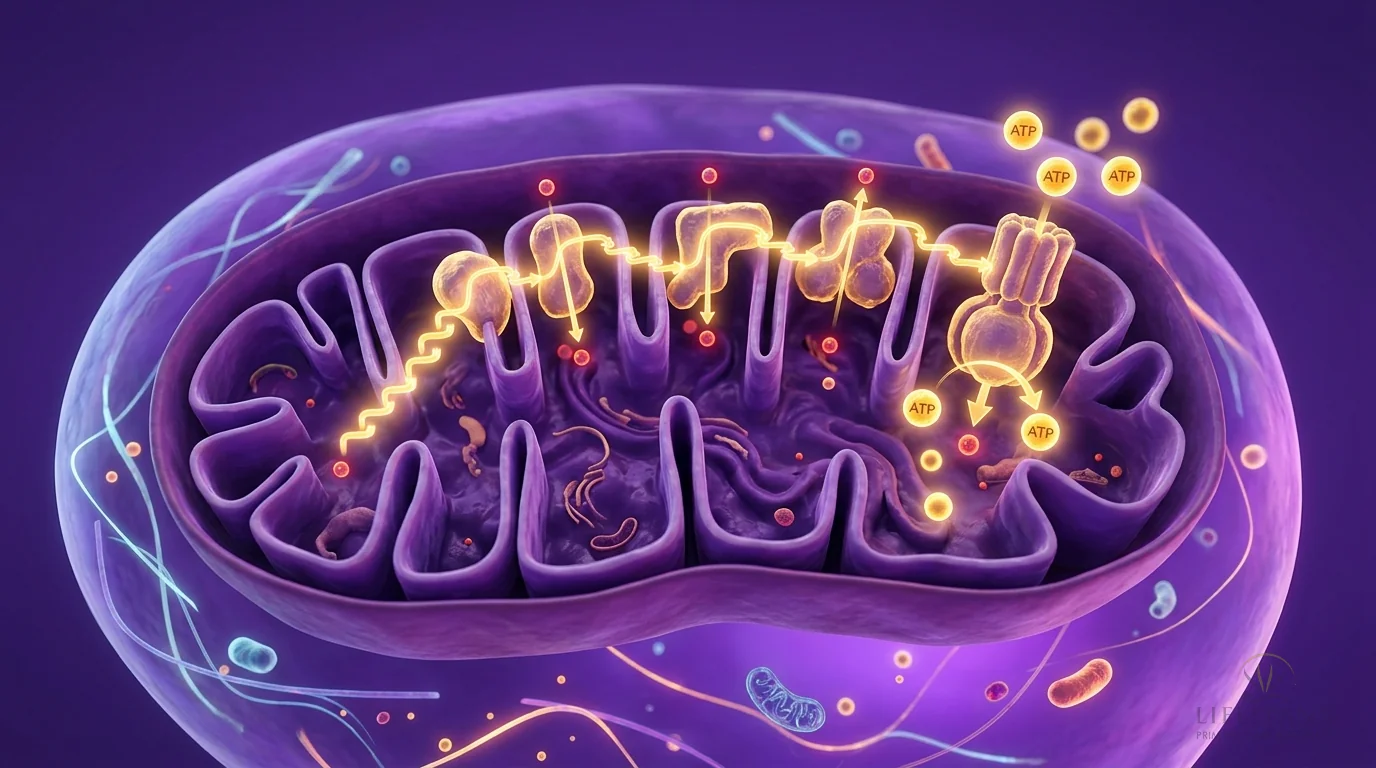
If you're tired all the time and coffee isn't cutting it anymore, this illustration explains what's actually going wrong — and how MOTC fixes it. You're looking inside a single mitochondrion, the tiny power plant inside nearly every cell in your body. A landmark study in Cell Metabolism identified MOTS-c as a mitochondrial peptide that mimics the effects of exercise at the molecular level — it improved glucose metabolism by 40% and activated the same master metabolic switch (AMPK) that exercise triggers. Those glowing golden structures along the folded inner membrane are the machinery that converts food into energy. MOTC tunes up this machinery so each cell produces more energy with less waste. Multiply that across trillions of cells and the difference is profound.
MOTS-c was identified as a mitochondrial-derived peptide that regulates metabolic homeostasis and mimics the effects of exercise at the molecular level. Treatment prevented age-dependent insulin resistance, improved glucose metabolism by 40%, and activated AMPK — the master metabolic switch typically only triggered by exercise or fasting.
MOTS-c administration reduced high-fat-diet-induced obesity by 15%, improved insulin sensitivity by 30%, and increased endurance capacity by 25% in aged subjects. The peptide enhanced mitochondrial respiration and fatty acid oxidation, confirming its role as a key regulator of whole-body energy metabolism.
The Transformation

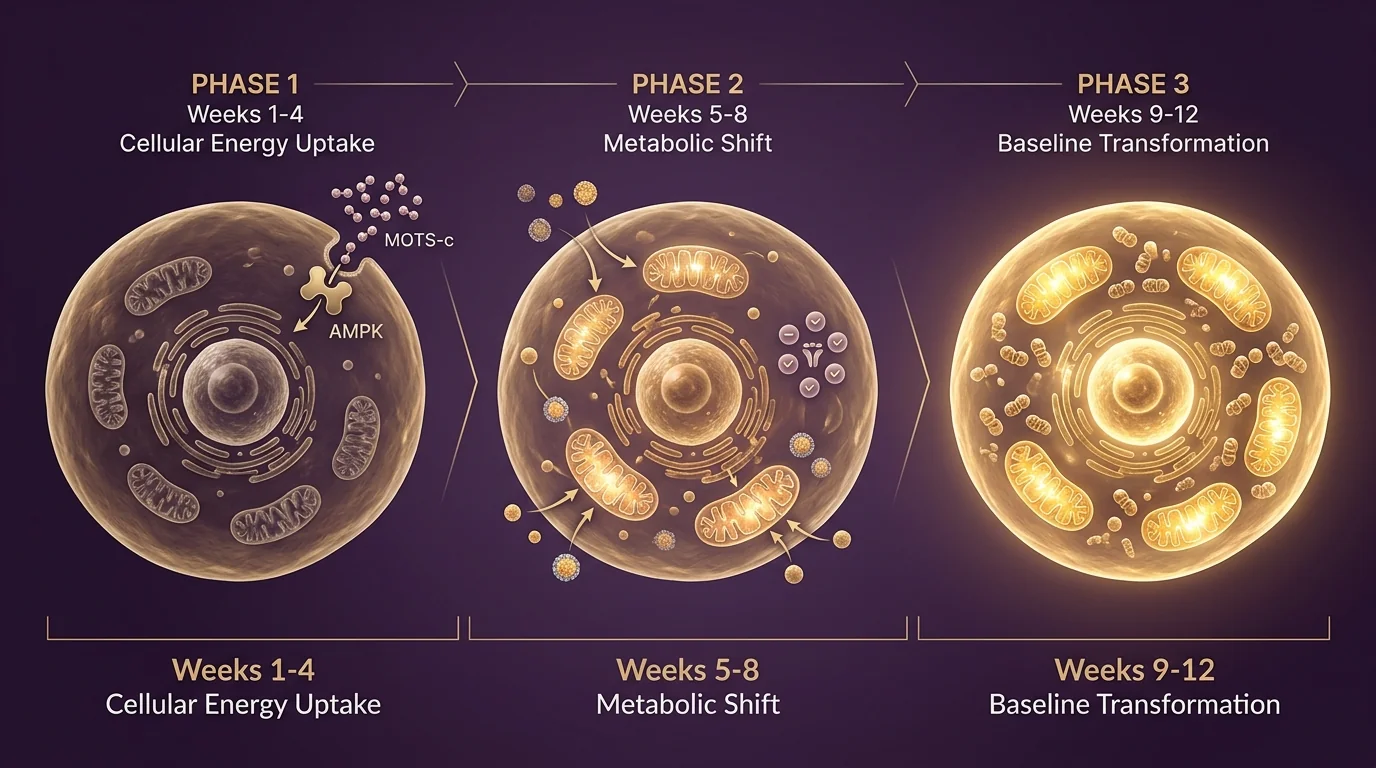
This is the before and after that patients can't see but absolutely can feel. On the left: cells with dim, tired mitochondria — barely producing enough energy to keep basic functions running. A 2021 study in Nature Communications found that even late-life MOTS-c treatment improved physical performance by 30% and activated stress-response pathways typically seen only in younger organisms. On the right, after MOTC: the same cells are glowing with energy. The mitochondria are brighter and more numerous — a 2019 study in Cell Metabolism confirmed that MOTS-c increased endurance capacity by 25% and enhanced fatty acid oxidation. MOTC doesn't just make existing power plants work harder — it tells your body to build new ones. This is why patients describe the shift as "feeling 10 years younger," not just "a little more awake."
Late-life MOTS-c treatment improved physical performance in aged mice by 30%, enhanced skeletal muscle metabolism, and activated stress-response pathways typically seen only in younger organisms. Endogenous MOTS-c levels were found to increase with exercise in humans, positioning the peptide as a natural exercise-mimetic that declines with age.
Comprehensive review of the mitochondrial-derived peptide family (MOTS-c, Humanin, SHLPs) showing systemic declines in circulating levels with age and reciprocal elevation in response to exercise, caloric restriction, and metabolic health. MOTS-c specifically acts as an anti-aging and anti-obesity signaling molecule, with therapeutic potential across type 2 diabetes, cardiovascular disease, and age-related cognitive decline.
Cross-over human trial confirmed that a single bout of high-intensity exercise elevated circulating MOTS-c 2.3-fold, and that exogenous MOTS-c administration improved glucose tolerance and insulin sensitivity in sedentary subjects to levels comparable to exercise-trained controls. The findings validate MOTS-c as a pharmacologic exercise-mimetic for patients with limited capacity to exercise.
What to Expect
Cellular Energy Uptake
Provider-directed home injection plan begins. Mitochondrial biogenesis and AMPK activation begin. Subtle energy shifts and improved exercise tolerance appear in weeks 2-3. Mental clarity often improves first.
Metabolic Shift
Insulin sensitivity improves (visible on HOMA-IR or fasting glucose). Exercise endurance noticeably better. Fatty acid oxidation accelerates — some patients notice reduced midsection fat without dietary changes.
Baseline Transformation
Sustained energy improvements. Exercise capacity at levels patients describe as "feeling 10 years younger." Follow-up metabolic panel at week 12 typically shows measurable HbA1c and lipid improvements.
Your Protocol at a Glance
Ideal For
Executives with brain fog, patients with chronic fatigue, biohackers pursuing longevity, anyone over 40 noticing declining energy.
Safety & Considerations
- Subcutaneous injection — well-tolerated with minimal adverse events in human and preclinical trials
- Caution with glucose-lowering medications (insulin, sulfonylureas) — MOTS-c enhances insulin sensitivity and may necessitate dose adjustments
- Diabetic patients should monitor glucose more closely during the first 4-6 weeks; coordinate with your endocrinologist
- Contraindicated during pregnancy; safety in lactation not established
- No known interactions with NAD+ IV therapy or other common longevity peptides — frequently paired
Stacks Well With
Patients commonly combine MOTS-c with these for complementary or synergistic effects:
Frequently Asked Questions
Ready to Start MOTS-c?
Add this to your plan so we can confirm the right protocol, pricing, and next steps at your consultation. Or book directly.
Cancellation Policy: A $50 non-refundable deposit is required to confirm your appointment for all consultations — our front desk will reach out to collect it after you book. The deposit is applied toward your visit cost. We require at least 24 hours' notice for cancellations or changes. No-shows or late cancellations will forfeit the deposit. By booking, you agree to these terms.
Business hours: Mon–Thu 8am–6pm · Fri 8am–12pm
Explore Other Peptides
 BPC-157
 TB-500
 Tesamorelin
 Sermorelin
 CJC-1295
 Semax
Semax Copper Peptide (GHK-Cu)
 PT-141 (Bremelanotide)
 Melanotan
 Glutathione Injections
 KPV
KPV DSIP
DSIP High Dose Vitamin C
 Venofer (Iron Infusion)
 ARA-290
 Wolverine (Recovery Stack)
 Captain America (Sleep Stack)
 Black Widow (Glow Blend)
 Deadpool (Healing+ Stack)